If the Laschamps geomagnetic excursion happened today, aviation radiation exposure would be radically altered – with “shielded pockets” in the north

The magnetic field protects Earth from harmful cosmic radiation and solar eruptions. However, its strength slowly varies over time. Occasionally, the field can even reverse, meaning the magnetic north and south poles switch places.
“The effects of a weakening and reversal of the magnetic field on the atmosphere and environment can be dramatic, yet still largely unknown. The consequences could be serious for our modern, highly technological society,” says Professor Ilya Usoskin from the University of Oulu, who is a principal investigator of the prestigious large-scale ERC-funded GERACLE project. The new study includes researchers from the Sodankylä Geophysical Observatory and the Space Physics and Astronomy Research Unit at the University of Oulu.
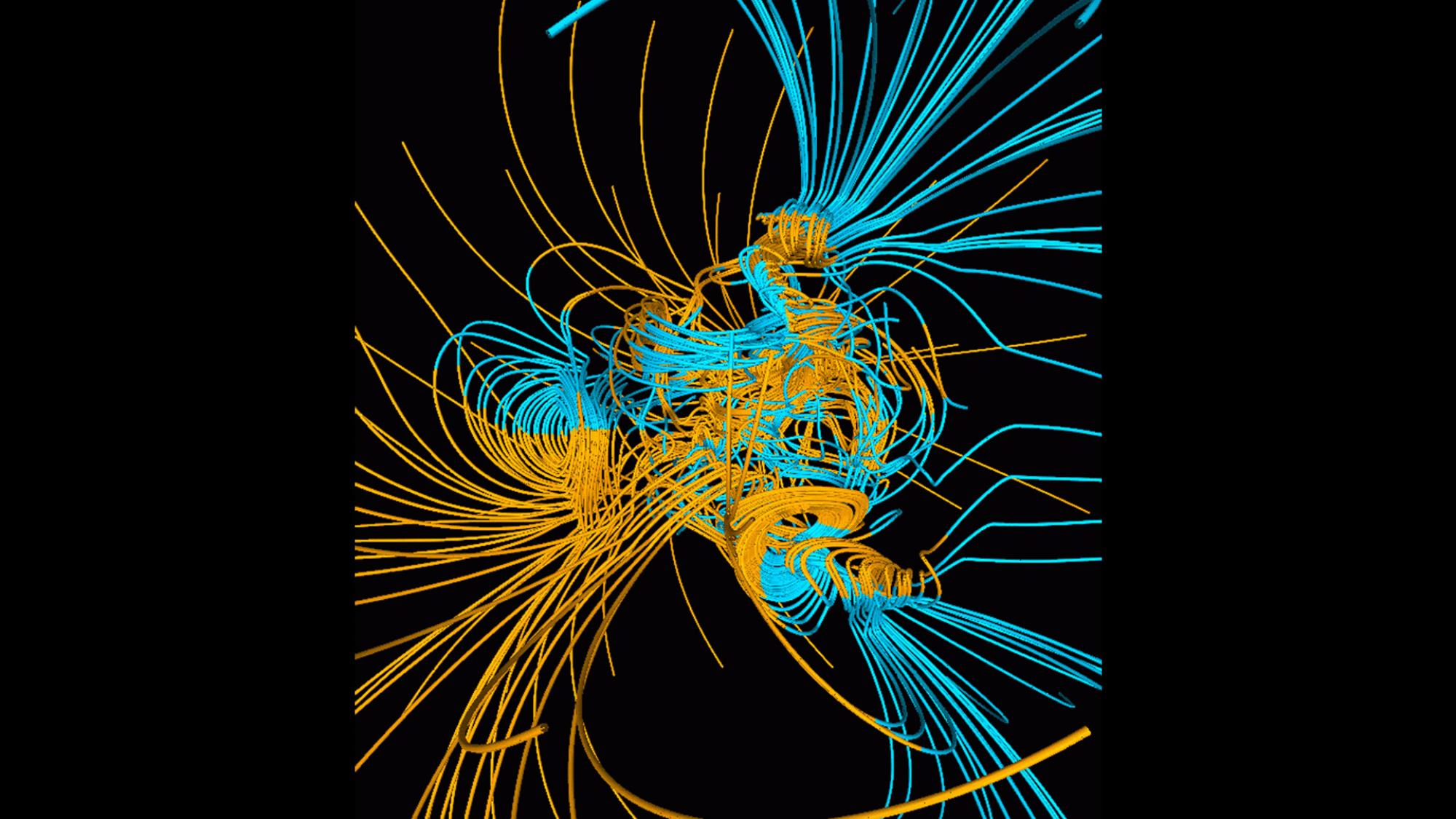
One of the most recent major variations of the geomagnetic field occurred about 41,000 years ago during the Laschamps excursion, when the magnetic field weakened to about five percent of its current strength and became multipolar in structure. The weakening phase lasted roughly two thousand years, and recovery took about five thousand years.
In the new study, researchers modelled the structure of the magnetic field and cosmic radiation throughout the Laschamps excursion. The modelling was based on the updated OTSO tool, developed by Usoskin’s team, and the LSMOD.2 paleomagnetic field model, built by GFZ in Potsdam, which reconstructs the Earth’s magnetic field in the past. The CRAC:DOMO model, also developed by the team, was used to calculate how much cosmic radiation affects the atmosphere—in other words, to estimate radiation doses affecting humans and technology.
The results show that cosmic radiation penetrated the atmosphere at record levels. The weakening magnetic field reduced the energy threshold required for cosmic particles to enter the atmosphere from today’s 17 gigavolts (GV) to only about 4 GV.
At the same time, regions where cosmic radiation could freely enter, the atmosphere expanded threefold irradiating a major fraction of the Earth’s atmosphere. Importantly, the exposure was not evenly distributed. The magnetic field became multipolar and irregular, directing cosmic particles in unexpected ways.
“When the magnetic field becomes multipolar, auroras can also appear in unusual locations around the globe,” notes Postdoctoral Researcher Pauli Väisänen.
Radiation would increase in unexpected regions
“The results show that during a weakened magnetic field, aviation risks do not increase uniformly everywhere. Instead, their geographical distribution changes in entirely new ways that cannot be inferred from present-day conditions,” says Väisänen.
The study modelled radiation exposure during the Laschamps event for two modern example routes: Helsinki–Dubai and Helsinki–New York. Under current understanding, high-latitude northern routes receive higher radiation exposure, while routes near the equator are well shielded. However, the new findings from the Laschamps period challenge these assumptions.
Surprisingly, some high-latitude northern routes—such as Helsinki–New York—could have been partially protected by “shielding pockets” formed by the multipolar magnetic field. In contrast, the more southern Helsinki–Dubai route would have experienced significantly higher radiation exposure, as the irregular magnetic field provided weaker protection there.
“In recent years, there has been growing concern about space weather, aviation safety, and cosmic radiation. These findings provide a new perspective to these discussions and a model for assessing similar weak-field scenarios in modern society,” the researchers conclude.
“Such geomagnetic excursions are not likely in the near future,” Usoskin and Väisänen reassure. However, current measurements show that Earth’s magnetic field has weakened by about nine percent over the past two centuries. The South Atlantic Anomaly—a region of particularly weak magnetic field—has also expanded in recent years.
The study was published on 24 February 2026 in Journal of Geophysical Research: Space Physics under the title: Reduced geomagnetic shielding during the Laschamps excursion and its impact on cosmic-ray-induced atmospheric radiation.
What is cosmic radiation?
Cosmic radiation consists of highly energetic particles originating from space, mainly produced by distant supernova explosions and other extreme astrophysical processes outside our galaxy, as well as sporadically by solar eruptions. Cosmic radiation can affect electronic devices and data processing, and distort atmospheric layers that carry radio signals.
At ground level, cosmic radiation currently accounts for about 10 percent of the natural radiation dose humans receive and generally does not pose harmful health effects. Learn more on European Space Agency's news. Aviation, especially over polar regions, is more susceptible to radiation.
The Sodankylä Geophysical Observatory of the University of Oulu continuously measures cosmic radiation as part of its extensive monitoring programme, which also includes the Earth’s magnetic field, ionosphere, cosmic radio noise, and energetic particles. In particular, cosmic radiation is measured with the Oulu neutron monitor, an instrument operating since 1964 that continuously and precisely records neutrons produced when cosmic particles interact with the atmosphere.
Further research is also conducted within the Research Council of Finland funded GERACLIS project.